
Laridae crew support citizen oceanography one Secchi disk at a time

Secchi Disk Project Logo

The crew of Laridae are proud to start contributing to the Secchi Disk Project by making our own Secchi disk, taking measurements during calm periods of our passages and in many anchorages, and uploading our data to the global database using the great app.  We lowered the disk into the water until it just disappeared from sight and then we noted the depth below the sea surface that this occurred, the Secchi Depth, from the marks on the rope.  So far, the record depth measured was 26.2 m in the middle of the Bay of Biscay!

From the Secchi Disk Project: “When a Secchi disk is lowered vertically into the water the depth below the surface at which it just disappears from sight is called the Secchi Depth. The Secchi Depth measures the clarity of the seawater, which away from estuaries and coasts indicates the amount of phytoplankton at the sea surface.  By measuring the Secchi Depth you can therefore help map the ocean’s phytoplankton.

Scientists fear the population of the microscopic beings is in decline due to rising sea temperatures and, if true, that could have  consequences for every aspect of marine life. Seafarers are being encouraged to take part in a unique global study, using a Secchi disk (a simple white disk with 30 cm diameter) and a mobile phone app called Secchi to record the effects of climate change. The public science project will measure the amount of phytoplankton, minute organisms at the very start of the marine food chain, currently residing in the worlds oceans.

Construction of the Secchi disk
All members of Laridae worked together to construct our own Secchi disk.  We were able to build the high-quality, marine-grade Secchi disk for £2.99 with only a saw and measuring tape!  We found a durable, white kitchen cutting board for sale in Falmouth for £2.99.  The size of the board was exactly 30 cm x 50 cm.  This was a perfect size to achieve a 30 cm diameter Secchi disk!  Angela carefully measured and sketched the 30 cm circle on the board and the adults on the boat took turn sawing the circle out of the rectangular board.

We already had a very long length of low-stretch Dyneema line that we used for CTD casts.  We laid this line along the deck and used a tape measure to accurately mark  Secchi depth distance measurements in 20 cm increments.  Once the circle was cut and line measured, a hole was drilled in the centre to hold the measured line on the top and a weight (made from spare rigging parts!) on the bottom.

We constructed the Secchi disk after we departed Falmouth, England while we were on passage across the Bay of Biscay to Spain.  Our first measurement was conducted in the very middle of Biscay (in 4000 m water depth!) during perfect conditions; sun, calm seas, and very clear blue water.  We recorded a Secchi depth of 26.2 m.  We have continued to collect additional Secchi depth measurements at several of the anchorages that we have enjoyed in Spain.

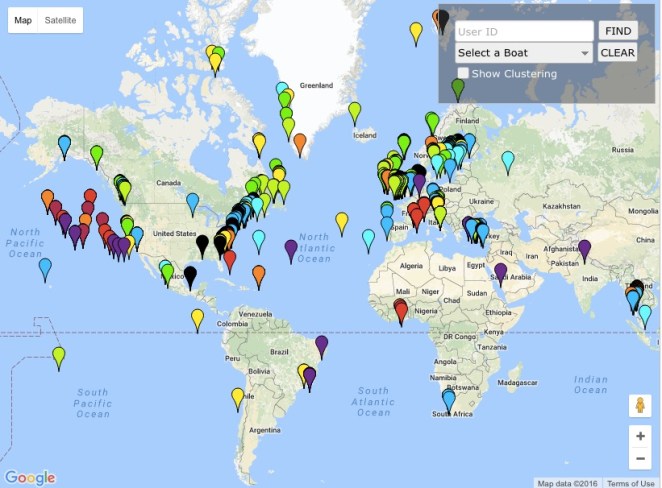
We use the great Secchi app to upload the Secchi depth, location, and other relevant information to the group’s global database.  Anyone can view all of the data using the interactive map of Secchi depths (shown below).  For just £2.99, and a little family-fun-construction-party, you can build your own Secchi disk and start contributing to this great citizen oceanography project!
SecchiMap

The Secchi Disk Project global database of Secchi disk measurements from citizen oceanographers.

 

Spain

by Dorian

When we got to Spain, we went to a town to look for flippers and snorkels.  We found a great place that had flippers, snorkels, sand buckets and spades.  After that, we went to the beach to try them out.  We saw a lot of fish.

The next day, we met up with some of my dad’s friends. They had four kids – all of them BOYS!  We went sailing with them.  While we were sailing, we took turns zooming around in the dinghy.  Later, we went to the beach with them and caught a lot of crabs and put them in one of our buckets.  One of the crabs was quite hairy.

The next day we went to their house which was nearby.  Their house was a 2-storey, stone house that was really fun!  We played in the boys’ rooms for a while and then we went into their pool.  We puffed up a floating whale and played a game where we had to try and stay on the whale without falling off.  In the end, EVERYONE fell off!  We had a very good time playing with them!

On our last day in Spain (until we get to the Canary Islands!), we went to get ice cream at a very fun place!  They let us have half of one flavour and half of another.  I chose half pistachio and half lemon.  The pistachio was my favourite!  Each half scoop was very big! Overall, it was the biggest and best ice cream that I have ever had!

All in all, it was a great time in Spain!

– Dorian (9)

Bay of Biscay oceanography lab

Sailing across the Bay of Biscay provided a great opportunity to experience many of the basic principles commonly taught in oceanography classes.   We used the passage from Falmouth, England to Vigo, Spain to observe the environment and sample the water like we were living in a large oceanography laboratory (and we were!).

Biscay SST Map Legend

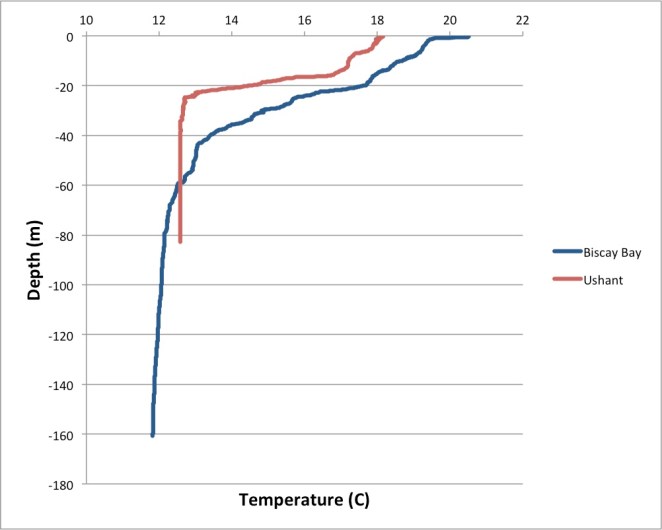
Sea Surface Temperature (SST) of our route between Falmouth and Vigo.  The two CTD locations are noted with stars at Ushant and near the centre of Biscay.

When we departed Falmouth, the surface water temperature was a cool 14.4° C. As we sailed southwards, towards Ushant (Ile D’Ouessant) off the coast of France near Brest, the waters began to warm up. The predominate water temperature near this region was about 17° C, but the sunny conditions combined with the light winds from the south probably contributed to the slightly warmer surface layer temperature of 18° C, as measured by the RBR CTD.

The following day we dropped off the shallow continental shelf (~100 m) into the deep plateau of the Bay of Biscay with a typical depth of about 4000 m.   We were motoring across Biscay in flat calm conditions, zero wind, and full sun! These conditions are rare in the middle of Biscay, so we took advantage of the sun and calm for a swim call in the deep, clear blue waters. Following the swim call, we took another CTD cast and measured the near-surface water of about 21° C. The warm surface water, heated by the sun in the calm conditions, quickly cooled to about 19° C below a sharp thermocline. Indeed, we could feel the temperature change when we dove off the deck and descended more than a few meters deep below the surface! We took advantage of these calm conditions to do a Secchi disk measurement and recorded a whopping 26.2 m depth in the clear water!

Biscay Bay Temperature PlotWhen the wind picked up from the North that evening, we were able to hoist the sails and start the fast downwind run to the corner of Spain and around Cape Finnisterre.  As we sailed through the southern part of the Biscay Bay, we crossed several ocean fronts that had clear lines of different currents and waves.  The frontal zones were as long as the eye could see, several hundred meters wide, and semi-periodic with a wave length of approximately 10 km.  Perhaps these were internal waves reaching the surface that were enabled by the strong and shallow thermocline from the calm, warm period?

As we rounded the northern tip of Spain and sailed towards Vigo, the seawater temperature (and air temperature!) dropped substantially.  This is the classic coastal upwelling case where the strong Northerly winds force the surface water to the right  (offshore) and the water near the coast is replaced by cold, nutrient rich deep water.  This is where the fishing is exceptional, and we dodged fishing boats for the next 50 miles until we reached the protected Ria of Vigo.

Secchi Deploy

Preparing to lower the RBR CTD in the warm, blue waters of Biscay Bay.

Secchi Lower

Taking a Secchi disk reading (26.2 m!) in Biscay Bay.

Bay of Biscay whales

by Dorian

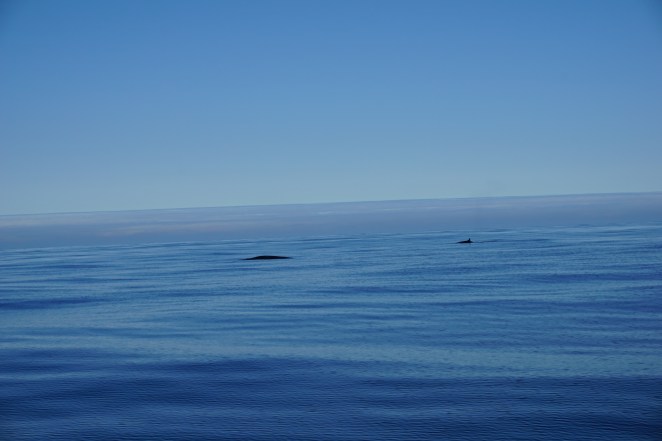
When we went to go across the Bay of Biscay, we saw a lot of whales! We think that we saw fin whales (or finback whales).They are the second biggest whales in the world – after the blue whale.  Daddy saw one whale breech. We all saw lots of whales squirt mist. It was really great to see something which we never saw before!

– Dorian (9)

Bay of Biscay (PASSAGE)

Finback whales

Bay of Biscay surprises

by Anneka

Roly-poly stories
I was quite worried about the Bay of Biscay for many reasons. First of all, our last overnight trip was crazy! It was extremely windy and rocky the whole time. It was even too rocky to see many dolphins. Second, there have been songs that say “…the Bay of Biscay swells will knock your head from off your shoulders.” Third, we met a family who told us that this was no joke.

Opposite of the songs
Our version of the Bay of Biscay was not at all windy. There was no wind in sight, not any waves, and it looked totally calm. We motored for sixty hours but it was still fun because we had a swim call! Everyone jumped in the water and splashed about. Not too many people can say they’ve done that.

Whales and dolphins
The one good thing that came from the calmness of the sea was dolphin and whale sightings. We saw lots of wildlife while on this trip. We saw at least one hundred dolphins and at least two whales a day. It was amazing! Whenever we saw a flock of birds on the water this far out at sea, we knew it was for only one thing — fish! And whenever there is fish, there are dolphins! And the fish eat smaller fish, and the smaller fish eat things like krill and plankton, and whales eat krill and plankton. All the wildlife could be seen in one spot!

Land ho!
We spotted land at about 5:00 in the morning. Even though Chris, mum, and Rob saw the lighthouse before that, my dad and Dorian were the first to shout “Land Ho!” It was the north tip of Spain. It looked like just a tiny sliver on the horizon (and I knew we wouldn’t be there for many hours), but I felt happy to smell the greenness and flowers of the earth. At first, I just felt relieved after five days at sea, but when I set foot on the still ground, I felt a feeling of accomplishment and I was proud to have crossed the Bay of Biscay!

– Anneka (11)

A calm day in Biscay

Day three at sea dawned even more calm than the previous day. Just as forecast, we were in the middle of a high pressure system and the wind speed would be exactly zero. The trusty motor continued to carry us through the glassy seas towards Spain. Little did we know, but glassy seas in Biscay provides plenty of opportunity to sight whales! Just after breakfast, we passed a small family of whales basking at the surface. We haven’t found the field guide to properly identify them yet, but we think that they may be Finback Whales. They were probably about 40 feet long, grey, and had a small but pronounced fin towards the rear of their back. As we continued to motor across the Bay, we had more whale sightings, as well as distant sighings of whales breaching and blowing. We also saw numerous dolphins plying the waves.

The sun warmed the surface waters to 23.5 C and we stopped the engine at about noon for a swim call. We drifted slowing in the calm sea for about an hour as we took turns jumping off the stern deck, the stern rail, and the cabin top into the very clear, but very deep, water. We freaked out the kids a bit by telling them that the closest land was 4000 m (2.5 miles) below us, and it would take hours for the camera to hit the bottom if they dropped it overboard. We have plenty of GoPro videos of shrieking kids (and adults) enjoying the swim (to be uploaded when we reach good WiFi).

We’ve been motoring towards Spain in the company of two other sailboats that we didn’t know, but could see on the AIS display. Sometime after the swim call, one of the boats called us on the radio and asked if we had any extra fuel to spare, as they were running low and would appreciate a resupply. We replied that we had enough fuel to spare some, but we didn’t have a pump to get the fuel out of the tanks. One of our trusty crew on board, Rob, replied “I’ve grown up working on farms with diesel tractors; I’ve spent my life running out of fuel, we get the fuel to them!”. So, we aimed our bow towards their AIS symbol on the chart and about an hour later parked next to them on the calm sea. They inflated their dinghy and rowed over with two 10 litre diesel can and an improvised pump. The fuel was extracted and we both continued motoring towards Spain.

The forecast is for another calm night and some tail winds to begin filling in after sunrise. We are hopeful that the wind will continue to fill and by mid-day (#4) we will have enough winds to carry us the rest of the ~200 miles to Spain. Remember that you can always track our progress on our maps on the Find Us! page of the website.

Surreal night watch

Day number two at sea was sunny and relaxing. We’ve been motoring most of the day as we are passing through a large high pressure system in the Bay of Biscay. We took a CTD cast off the French coast of Ushant and we deployed the fishing gear (but have not deployed the catching gear yet!). The surface water has warmed from the chilly 14 C of Scotland to a relatively balmy 21 C. The air is just as clear and warm as the sea.

Now, we are enjoying a surreal night watch. Glassy calm seas, surrounded by stars above and French accents on the VHF radio, while rocking-out to Hamilton on the iPad.

We are expecting another calm day tomorrow and I have promised a swim call in 4000 m (2.5 miles!!!) deep water in the middle of Biscay if the water temp rises above 23 C.

English Channel “close” calls

The scale of everything at sea is not that of life ashore. Small dinghies are happy to come within centimetres of each other as they jockey for position at the starting line of a race. Larger racing boats are content to pass within metres of each other at great speed. However, when there are miles of ocean around you to spare, coming within a few nautical miles of another ship seems too close! For this crossing, we are happy to have two extra sets of eyes on board to join in the boat-watching. Chris O’Brien and Rob Stevens have joined us for the leg from Falmouth to Spain.

Crossing the English Channel and the Traffic Separation Scheme near France, we kept close tabs on all ships passing within 5 nautical miles of us. We joked that when Rob, Anneka and I (Angela) were on watch from 7-10pm, we took great care to avoid any close encounters. We noted an expectation of “CLOSE” contact with a tanker named “Caribbean Highway” from the moment he was within 14 nautical miles of us. At that point he was 45 minutes away! Thanks to AIS, we were able to see that our CPA (closest point of approach) was going to be less than 0.3 nautical miles. CLOSE! We have laughed about what “close” means out here and how we planned and enacted our “evasive action” for something that at that point was a city away and which was predicted to be (gasp) nearly 2 blocks away from us at its closest point! Ironically, near the time of our CPA, we spotted dolphins alongside our boat. All large ships were clearly forgotten!

At 0900 on Saturday the 6th of August, we are just now passing Le Four and Iles D’Ouessant, France. Land has been spotted and we have turned our course beyond it towards Spain. It is a calm day and we are, at the moment, motoring with less than 5 knots of wind. We will plan to do some oceanographic measurements (CTD and secchi disk, more info to follow!) as we cross Biscay while the wind is light. Hopefully we will also put out some fishing lines!

Happy sailing!

Dinner and a show!

We have enjoyed the first 30 miles of our 500 mile passage to Northern Spain. After setting sail from Falmouth at 1:30 PM, we enjoyed some nice sunny weather and close-reaching on starboard tack in about 10-15 knot winds. After enjoying a nice dinner of warmed Cornish Pasties, we were entertained by a showing of two small dolphins. Later, we saw a nice sunset and now we are dodging shipping traffic across the English Channel. The off-watch is sleeping and I should get back on deck! 🙂 No photos at the moment because we are updating the blog via sat phone. Hopefully loads of photos upon our arrival early next week.

Setting off for Spain

We are ready to leave Falmouth after fun week enjoying our last days in the UK (for now). We are prepped and ready for our voyage to Spain.

The 500-mile trip should take us four days and we expect to arrive Tuesday evening. You can follow us on our website tracker maps.

We are looking forward to tapas and sunshine!